

Book Review Template
Free Markdown book review template. Covers rating, summary, key takeaways, favorite quotes, and who should read it. Publish to a shareable URL in one click.
Free. No signup required.
Preview
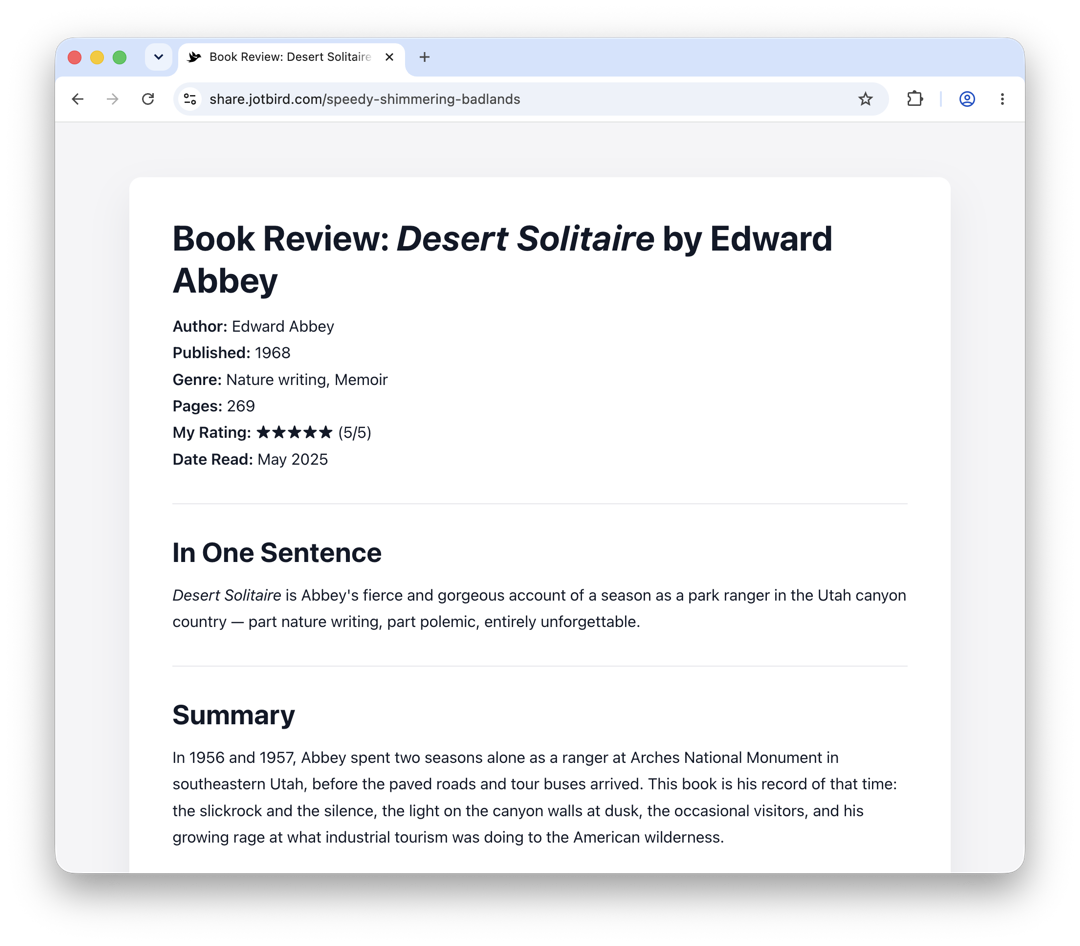
This is what your published page will look like. Customize it in the editor, then share the link.
Book Review: Desert Solitaire by Edward Abbey
Author: Edward Abbey
Published: 1968
Genre: Nature writing, Memoir
Pages: 269
My Rating: ★★★★★ (5/5)
Date Read: May 2025
In One Sentence
Desert Solitaire is Abbey's fierce and gorgeous account of a season as a park ranger in the Utah canyon country — part nature writing, part polemic, entirely unforgettable.
Summary
In 1956 and 1957, Abbey spent two seasons alone as a ranger at Arches National Monument in southeastern Utah, before the paved roads and tour buses arrived. This book is his record of that time: the slickrock and the silence, the light on the canyon walls at dusk, the occasional visitors, and his growing rage at what industrial tourism was doing to the American wilderness.
Abbey writes about the desert the way other writers write about people — with intimacy, humor, and moral seriousness. The book moves between lyrical description, philosophical digression, and outright provocation. He doesn't want you to visit the wilderness. He wants you to go into it, on foot, unprepared, and be changed.
Key Takeaways
- Wilderness has value precisely because it is useless. Abbey resists every argument that justifies wild land by its recreational or economic utility. A place doesn't need to serve us to deserve protection.
- The road is the enemy. Roads don't bring people closer to nature — they bring nature closer to people who never have to leave their cars. Abbey saw this clearly in 1967 and it has only gotten more true.
- Solitude is not loneliness. Some of the most alive writing in the book describes Abbey alone for days, deeply content, watching a thunderstorm build over the canyon.
- Anger and beauty can coexist. Abbey is furious and joyful in the same paragraph. The book models how to care about something without sentimentalizing it.
Favorite Quotes
Do not burn yourselves out. Be as I am — a reluctant enthusiast... a part-time crusader, a half-hearted fanatic.
The strangeness and wonder of existence are emphasized here, in the desert, by the comparative sparseness of the flora and fauna: life not crowded upon life as in other places but scattered abroad in spareness and simplicity.
Better a cruel truth than a comfortable delusion.
Who Should Read This
Anyone who has ever stood somewhere beautiful and felt, alongside the beauty, a low-grade grief about what's being lost. Essential reading for anyone interested in environmental writing, the American West, or what it means to pay attention to a place.
Related Books
- Walden by Henry David Thoreau — the obvious antecedent; Abbey is Thoreau with more whiskey and less patience
- The Monkey Wrench Gang by Edward Abbey — Abbey's novel; fiction, but continuous with this book's arguments
- The Unsettling of America by Wendell Berry — the same argument Abbey makes, applied to farming and agrarian culture
How to customize
Replace the book title, author, and metadata at the top. Be specific in your key takeaways — generalities aren't useful to future readers. The "Who Should Read This" section helps others quickly decide if the book is relevant to them.
Markdown source
# Book Review: *Desert Solitaire* by Edward Abbey

**Author:** Edward Abbey
**Published:** 1968
**Genre:** Nature writing, Memoir
**Pages:** 269
**My Rating:** ★★★★★ (5/5)
**Date Read:** May 2025

---

## In One Sentence

*Desert Solitaire* is Abbey's fierce and gorgeous account of a season as a park ranger in the Utah canyon country — part nature writing, part polemic, entirely unforgettable.

---

## Summary

In 1956 and 1957, Abbey spent two seasons alone as a ranger at Arches National Monument in southeastern Utah, before the paved roads and tour buses arrived. This book is his record of that time: the slickrock and the silence, the light on the canyon walls at dusk, the occasional visitors, and his growing rage at what industrial tourism was doing to the American wilderness.

Abbey writes about the desert the way other writers write about people — with intimacy, humor, and moral seriousness. The book moves between lyrical description, philosophical digression, and outright provocation. He doesn't want you to visit the wilderness. He wants you to go into it, on foot, unprepared, and be changed.

---

## Key Takeaways

- **Wilderness has value precisely because it is useless.** Abbey resists every argument that justifies wild land by its recreational or economic utility. A place doesn't need to serve us to deserve protection.
- **The road is the enemy.** Roads don't bring people closer to nature — they bring nature closer to people who never have to leave their cars. Abbey saw this clearly in 1967 and it has only gotten more true.
- **Solitude is not loneliness.** Some of the most alive writing in the book describes Abbey alone for days, deeply content, watching a thunderstorm build over the canyon.
- **Anger and beauty can coexist.** Abbey is furious and joyful in the same paragraph. The book models how to care about something without sentimentalizing it.

---

## Favorite Quotes

> Do not burn yourselves out. Be as I am — a reluctant enthusiast... a part-time crusader, a half-hearted fanatic.

> The strangeness and wonder of existence are emphasized here, in the desert, by the comparative sparseness of the flora and fauna: life not crowded upon life as in other places but scattered abroad in spareness and simplicity.

> Better a cruel truth than a comfortable delusion.

---

## Who Should Read This

Anyone who has ever stood somewhere beautiful and felt, alongside the beauty, a low-grade grief about what's being lost. Essential reading for anyone interested in environmental writing, the American West, or what it means to pay attention to a place.

---

## Related Books

- *Walden* by Henry David Thoreau — the obvious antecedent; Abbey is Thoreau with more whiskey and less patience
- *The Monkey Wrench Gang* by Edward Abbey — Abbey's novel; fiction, but continuous with this book's arguments
- *The Unsettling of America* by Wendell Berry — the same argument Abbey makes, applied to farming and agrarian culture


Ready to use this template?
Open it in the editor — no signup needed.