

Blog Post Template
Free Markdown blog post template. Includes intro, sections, code blocks, and blockquotes. Customize in your browser, publish to a shareable URL in one click.
Free. No signup required.
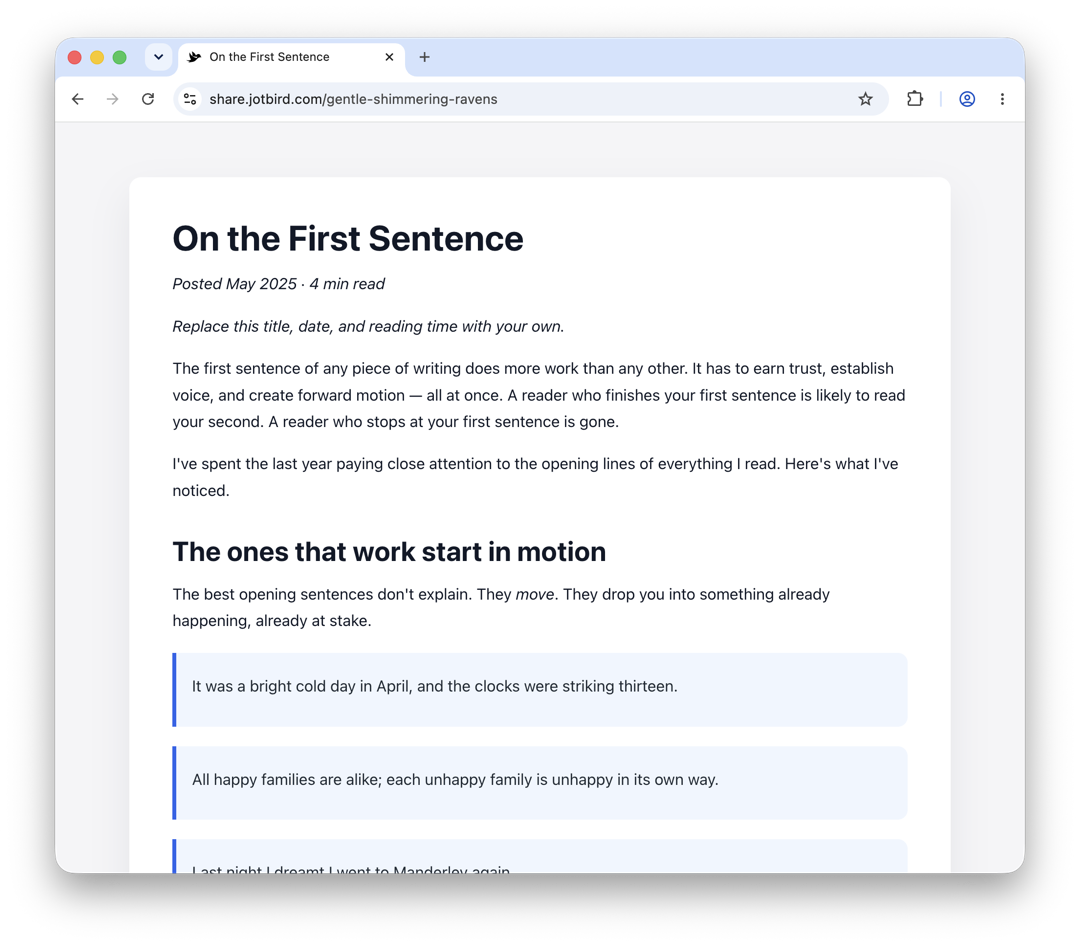
Preview
This is what your published page will look like. Customize it in the editor, then share the link.
On the First Sentence
Posted May 2025 · 4 min read
Replace this title, date, and reading time with your own.
The first sentence of any piece of writing does more work than any other. It has to earn trust, establish voice, and create forward motion — all at once. A reader who finishes your first sentence is likely to read your second. A reader who stops at your first sentence is gone.
I've spent the last year paying close attention to the opening lines of everything I read. Here's what I've noticed.
The ones that work start in motion
The best opening sentences don't explain. They move. They drop you into something already happening, already at stake.
It was a bright cold day in April, and the clocks were striking thirteen.
All happy families are alike; each unhappy family is unhappy in its own way.
Last night I dreamt I went to Manderley again.
None of these tell you what the book is about. All of them make you want to know what happens next.
The ones that don't work announce themselves
The weakest openings are the ones that start by describing what they're about to say:
- "In this post, I'm going to discuss..."
- "This is a topic that many people find interesting..."
- "There are many ways to approach the question of..."
These sentences have no energy. They exist to fill space while the writer gets to the thing they actually want to say. Cut them and start with the next sentence — it's almost always better.
The test I use now
When I finish a draft, I read just my first sentence out loud and ask one question:
Does it make me want to read the second sentence?
If no, I rewrite until it does. Sometimes the right opener is buried three paragraphs in. Sometimes it's what I had planned as the conclusion. The right place to begin is wherever the energy is.
What this changed
I spent years writing first sentences that were accurate, informative, and dull. I thought the job of an opening was to orient the reader — to tell them what they were about to learn. I was wrong.
The job of the first sentence is to earn the second. Everything else follows from that.
Thanks for reading. If this was useful, feel free to share the link.
How to customize
Replace the title, date, and reading time estimate at the top. Rewrite the body sections with your own argument, evidence, and conclusions. The blockquote and code block examples show formatting you can use throughout — delete or adapt them to suit your topic.
Markdown source
# On the First Sentence

*Posted May 2025 · 4 min read*

*Replace this title, date, and reading time with your own.*

The first sentence of any piece of writing does more work than any other. It has to earn trust, establish voice, and create forward motion — all at once. A reader who finishes your first sentence is likely to read your second. A reader who stops at your first sentence is gone.

I've spent the last year paying close attention to the opening lines of everything I read. Here's what I've noticed.

## The ones that work start in motion

The best opening sentences don't explain. They *move*. They drop you into something already happening, already at stake.

> It was a bright cold day in April, and the clocks were striking thirteen.

> All happy families are alike; each unhappy family is unhappy in its own way.

> Last night I dreamt I went to Manderley again.

None of these tell you what the book is about. All of them make you want to know what happens next.

## The ones that don't work announce themselves

The weakest openings are the ones that start by describing what they're about to say:

- "In this post, I'm going to discuss..."
- "This is a topic that many people find interesting..."
- "There are many ways to approach the question of..."

These sentences have no energy. They exist to fill space while the writer gets to the thing they actually want to say. Cut them and start with the next sentence — it's almost always better.

## The test I use now

When I finish a draft, I read just my first sentence out loud and ask one question:

**Does it make me want to read the second sentence?**

If no, I rewrite until it does. Sometimes the right opener is buried three paragraphs in. Sometimes it's what I had planned as the conclusion. The right place to begin is wherever the energy is.

## What this changed

I spent years writing first sentences that were accurate, informative, and dull. I thought the job of an opening was to orient the reader — to tell them what they were about to learn. I was wrong.

The job of the first sentence is to earn the second. Everything else follows from that.

---

*Thanks for reading. If this was useful, feel free to share the link.*
Ready to use this template?
Open it in the editor — no signup needed.